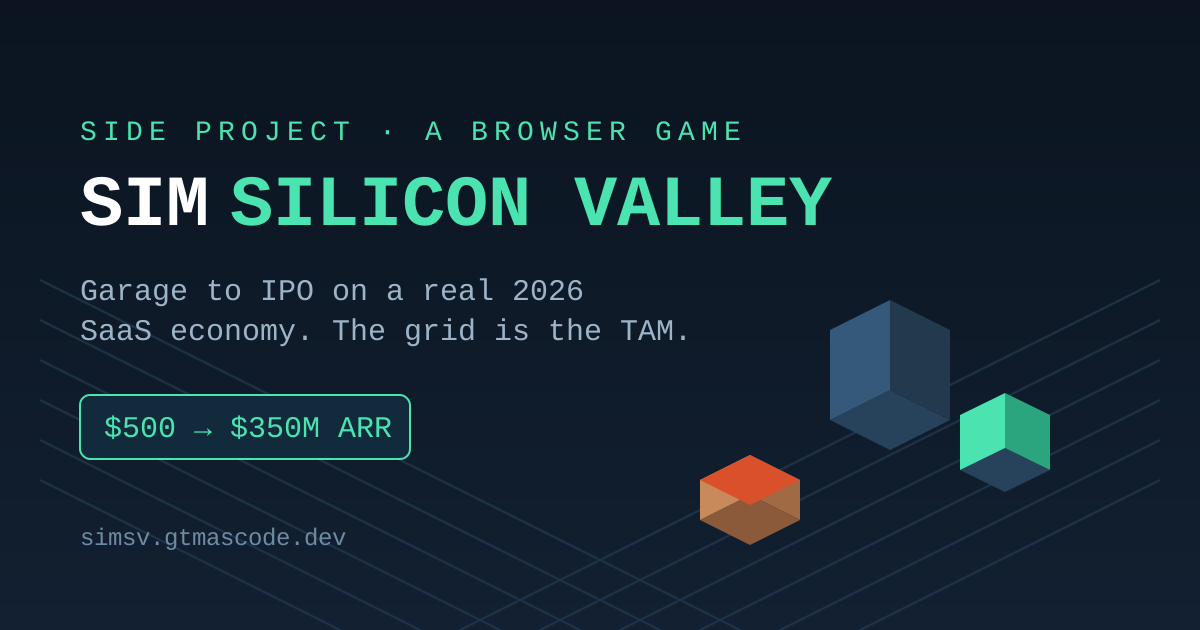
I built a city builder about the only city I know well enough to satirize: Silicon Valley. Sim-SiliconValley is a 3D browser game where you leave Big Tech with $500, a garage, and a cofounder, and try to reach IPO. It is live at simsv.gtmascode.dev, it runs on a real 2026 SaaS economy, and it is my favorite kind of vibe coding project: one where the joke only lands if the underlying model is accurate.
This follows the same side-project thread as my Hebrew cryptic crossword solver: pick something playful, then take the engineering underneath it completely seriously.
The grid is the TAM
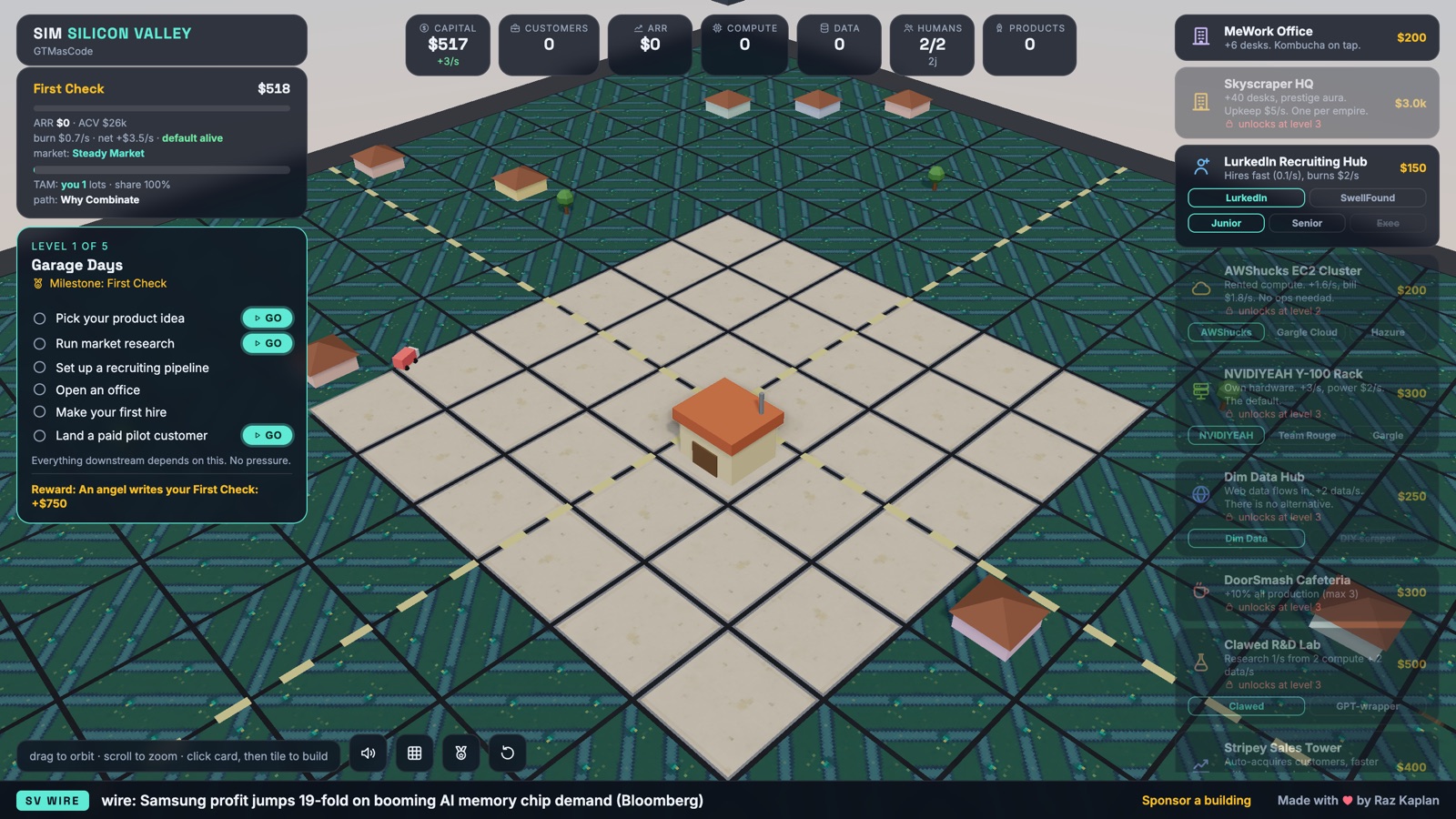
The core design idea came from staring at SimCity screenshots: in a city builder, land is the scarce resource. In a startup, that resource is the total addressable market. So the game board is literally the TAM. You claim lots, rival clone factories incorporate the day you do and build on your map, and your market share is visible as territory. When the Funding Winter scenario rotates in, valuations compress on the same board you built during the good times, because that is what actually happened.
The economy underneath uses real numbers: median ACV, EV/ARR multiples, salary bands, office rents. Customers pay recurring revenue, products raise your prices, and three resources build products: Compute, Data, and Humans.
Investors are playbooks, not checkboxes
Picking an investor does not wire a check. Each firm is a path you have to walk:
- Why Combinate: apply to the batch, survive office hours, pitch Demo Day. Your R&D ships 30% faster.
- Redwood & Redwood: partner coffee, default-alive metrics, the board deck. Plus 20% on all revenue, forever.
- b17z Capital: viral demo, podcast circuit, term sheet negotiation. Compute 25% cheaper, checks 40% bigger.
Levels are badge checklists with real tradeoff decisions: usage-based versus per-seat versus enterprise pricing changes your revenue modifiers permanently, and an aggressive term sheet is not the same company as a clean one. Garage Days ends with an angel check; the final boss is ringing the bell at $350M ARR.
Vendors as a go-to-market surface
Every vendor in the build palette is a loving parody until the real company sponsors the slot: NVIDIYEAH racks, AWShucks clusters, LurkedIn recruiting, Stripey sales towers, a Clawed R&D lab, and Dim Data, the only data source in the valley. The palette also shows a DIY scraper option, permanently disabled: everyone tries, nobody succeeds.
That sponsorship mechanic is the go-to-market experiment hiding inside the game. The parody slots are ad inventory with built-in affection, the sponsors page is the rate card, and the Hall of Unicorns count is the single public traction number the whole funnel optimizes toward.
Built by an agent that ships daily
The game is vibe coded end to end, and it stays alive the same way: a daily agent picks one item off the roadmap, implements it, and ships it. The commit log doubles as a devlog. The polish layer, original SVG icons, WebAudio-synthesized sound, confetti, orbiting title camera, and blinking vendor-colored GPU LEDs, accumulated one autonomous day at a time.
The analytics funnel is deliberately simple: game_start, level_up, ipo. Each stage is an event, the drop-offs tell me which level loses players, and the leaderboard had to be hardened before any public push because incremental-game communities find every exploit within 48 hours.
Play it
Start in the garage at simsv.gtmascode.dev. Name the company something you will not regret; the name outlives the pivot.
Share this post
Related Posts
Subscribe to the Newsletter
Get the latest insights on vibe coding and marketing delivered to your inbox.