Building in public is over.
That is my provocation for startup GTM in 2026-2027. Modern marketing has spent years telling founders to share the journey: ship visibly, publish the numbers, narrate the experiments, turn an audience into customers. The bargain was attractive. Attention today would become an advantage tomorrow.
But what happens when the audience can reproduce the product almost as quickly as it can understand it?
The dangerous competitor is no longer only another founder with a weekend and a coding agent. It is also a company with frontier models, capital, existing customer relationships, and distribution built into the places your prospective customers already spend their time. Your launch can teach both kinds of competitor what deserves to exist.
I think this changes more than the advice we give founders about posting. It should change the kind of company they build.
In The Work of Art in the Age of Mechanical Reproduction, written in 1935 and first published in 1936, Walter Benjamin examined how reproduction transforms our relationship with art. His concept of aura concerns the original work's unique presence, its history, and its place in a tradition. Reproduction changes the conditions under which people encounter and value it.
Benjamin was writing about art, culture, and politics. I am borrowing a question from him: when the means of reproduction change, what happens to the value we assigned to the original?
Software has always been copyable. What is changing is the effort required to reconstruct a useful experience from its visible behavior. A workflow, a demo, and a clear statement of the customer problem can become a practical brief for a competing product. The implementation may differ completely. The customer may still see two ways to accomplish the same thing.
There are limits. A polished demo does not reproduce reliability, proprietary research, or years of operational knowledge. Yet a competitor does not need to reconstruct your entire company to undermine your GTM. It needs to reproduce enough of the promise to make your prospective buyer hesitate.
Being the original is a fact about chronology. Becoming the default is a commercial achievement. The distance between those two things is where I expect more startups to struggle.
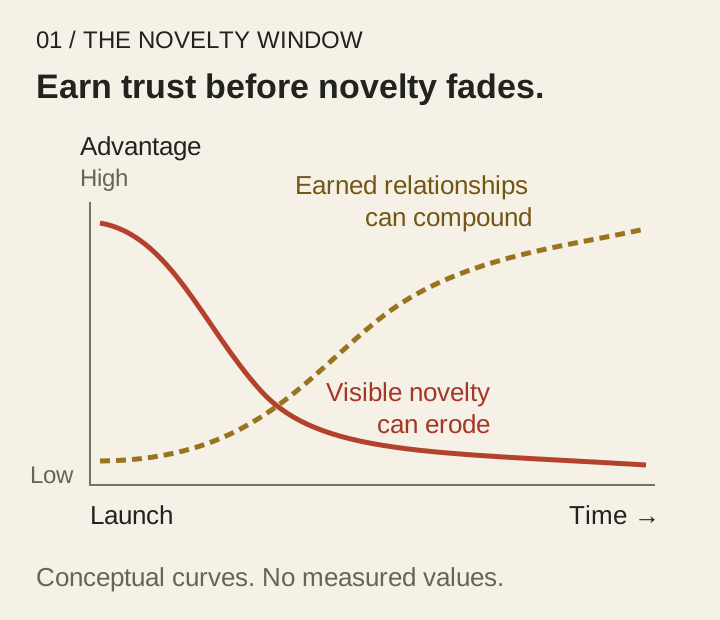
The GTM challenge: turn the early window of novelty into a relationship that lasts. These curves illustrate the argument; they are not market measurements.
Consider Instinct, the personal assistant that connects to applications and devices and can act through familiar forms of communication. Its promise includes following up on forgotten threads, arranging services, and handling everyday tasks. It is still offered through private access and invitations.
By August 24, Instinct was drawing widespread attention. On September 8, roughly two weeks later, Meta introduced Muse: a personal agent accessed through its own app or WhatsApp, able to take actions across applications, send emails, and book travel. The overlap in the customer promise is striking.
That sequence does not establish that Meta copied Instinct or built Muse in response to it. Nor does it prove equivalent performance. Instinct's private rollout also makes it an imperfect example of building in public. The case illustrates something broader: even a carefully controlled debut can coincide with a giant entering substantially the same territory.
For a founder, the strategic question arrives before the technical comparison is settled. How long do you have to turn curiosity into a durable customer relationship when a familiar platform is making a similar promise?
This is why I think building in public has expired as a default strategy. Its economics need to be argued each time. An audience of committed customers, contributors, or practitioners can be enormously valuable. An audience that mostly observes your product discoveries may be helping competitors as much as it helps you.
I would still publish a strong point of view. I would still show evidence that the product works. I would work closely with customers and invite them into the development process. But I would be deliberate about which discoveries become public, and when. The customer insight, the channel that converts, and the next workflow worth owning are operating assets. Sharing them should have an expected return.
This puts pressure on something I have celebrated before. In my PostHog GTM analysis, I argued that openness can itself become distribution. I still believe that. The harder question now is whether a particular act of openness strengthens the customer relationship faster than it makes the opportunity easier to reproduce.
The usual answer is to find a better moat: proprietary data, deeper integrations, community, brand, switching costs. All useful. All incomplete as a response to this problem.
A moat describes an advantage you hope to defend. GTM determines how you acquire customers and accumulate that advantage in the first place. If the product's novelty expires before its acquisition costs are recovered, a slide about future defensibility will not rescue the business.
My bet is that one promising company structure for 2026-2027 is a portfolio of products that share the same brain.
By brain, I mean accumulated understanding of one customer world: its entities, workflows, exceptions, relationships, and measures of success. That understanding should be expressed in reusable software, permissioned context, evaluation methods, and operating knowledge. Pointing five interfaces at the same model API is too thin a foundation.
Imagine a company dedicated to independent home-service businesses. Its thesis is that a small operator should be able to run a larger business without adding an administrative layer every time revenue grows.
It might begin with a product that recovers missed calls and turns them into qualified appointments. Once that works, the company could add estimate follow-up, scheduling, invoice collection, and maintenance reminders. Each addresses a different moment of urgency. Each can have a focused promise and its own commercial logic. Together, they use the same understanding of the business's customers, jobs, availability, and history, within the permissions the operator grants.
A contractor arrives because missed calls are costing money. The relationship can expand when accepted estimates expose a scheduling problem or completed jobs reveal a collections problem. The next product has a reason to appear in the customer's life. The company has already earned some trust and learned how the business works.
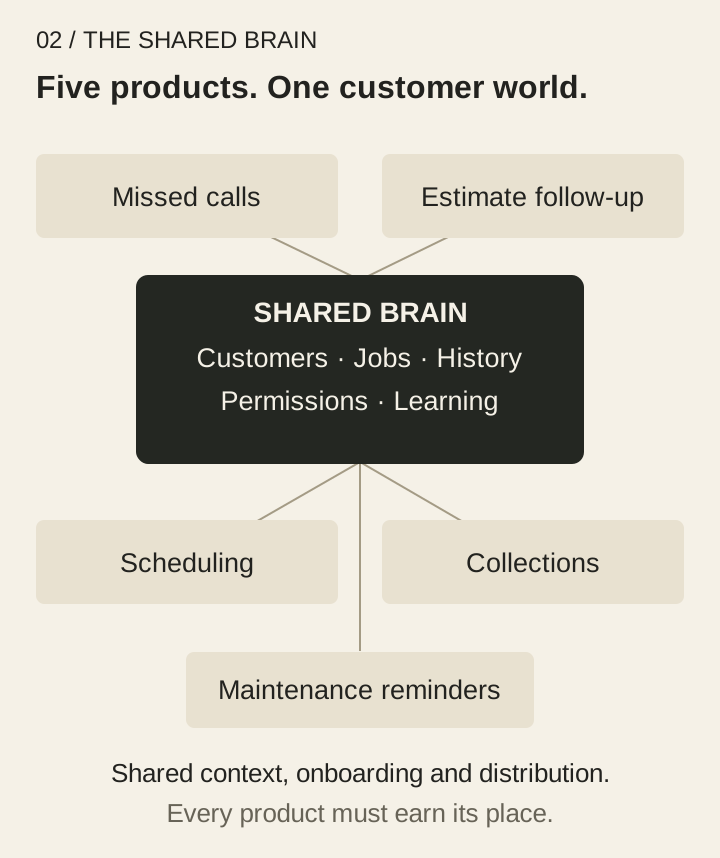
Different entry points into the same customer world. The shared asset is an understanding of the business, with permission to use that context across its workflows.
That is a different GTM structure from launching an unrelated tool and buying attention from scratch every time. Multiple products create multiple entrances into the same customer relationship. Shared onboarding reduces repeated setup. Existing channels can introduce the next product. A useful integration can make the combined experience better than the sum of its parts.
These are hypotheses to measure, not benefits to assume. Does the second product actually cost less to sell? Does shared context improve outcomes? Do customers using two products stay longer because they receive more value? Can each product justify its support and inference costs? If the answers are no, the portfolio may simply be several expensive distractions.
The operating model begins to resemble a small private equity firm dedicated to one thesis. The founders allocate capital and talent across a set of related products. They build some, may acquire others, improve shared operations, and stop funding weak bets. Cash generated by a mature product can support an adjacent experiment.
The PE analogy is about capital allocation and operating discipline. It does not require debt, acquisitions, or financial engineering. A young software company can adopt that discipline while building every product itself. The important move is to treat an individual product as one expression of the thesis, with a budget and a burden of proof.
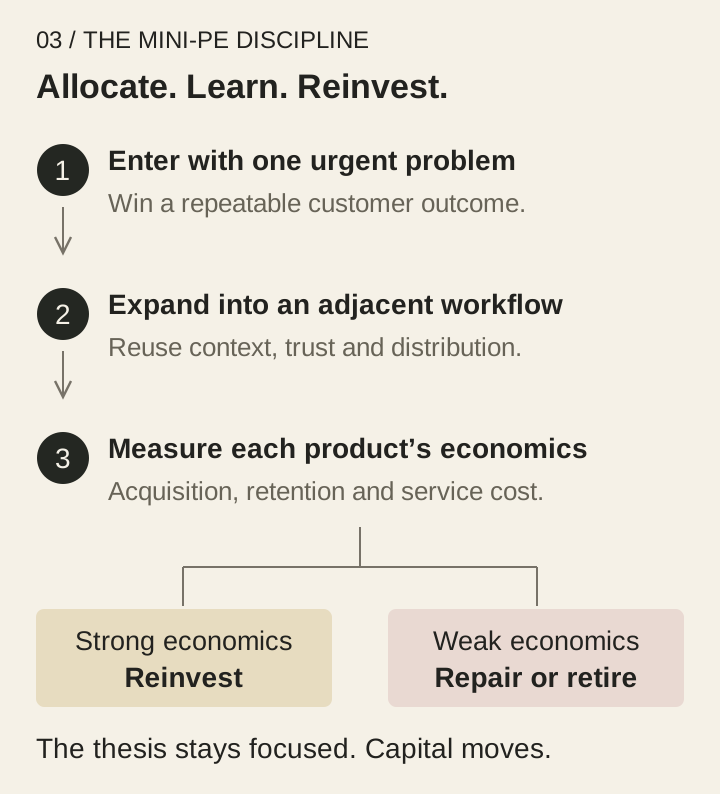
A portfolio is an ongoing allocation decision. Shared infrastructure earns its value only when the individual products earn theirs.
Focus still matters. It moves up a level: one customer world, a bounded set of problems, and a coherent reason to own them together. I would start with one painful problem and earn the right to expand. Designing for reuse early is sensible. Maintaining five unvalidated products early is usually a way to avoid finding out whether any one of them matters.
There is also a real trap here. Five products built on the same vulnerable capability are five exposures to the same risk. A platform can bundle a whole suite. A shared brain can become a shared point of failure. Different buyers, procurement processes, and support demands can erase the supposed economies. The portfolio only helps when customer understanding and distribution compound across it.
For founders, this suggests a more selective launch strategy. Work with a small set of customers until the first product produces a repeatable outcome. Build the next product around an observed adjacent need. Reuse access and context with permission. Publish enough proof to earn the next relationship, and measure whether public attention becomes activation and retention. The launch should accelerate a working commercial system.
For VCs, it changes the diligence questions. Alongside product-market fit, I would ask how efficiently the company can enter an adjacent workflow. What does a second product inherit? Which costs are actually shared? Who decides to close a product? Does each additional line improve the economics of serving the same customer, or merely increase the number of things the founders can demo?
A VC already owns a portfolio, but that diversification happens across separate companies. It does not automatically create shared distribution or customer context inside any of them. An operating portfolio has to earn those benefits. And a disciplined, profitable collection of niche products will not necessarily produce venture-scale returns. The financing should fit the ambition and the economics.
I expect both forms to matter: narrowly focused products that earn exceptional depth, and companies whose strength comes from a family of products built around one durable understanding of a market. My argument is that founders and investors should consider the second form much earlier, while they are designing GTM, rather than treating it as something only mature companies are allowed to do.
Benjamin's question keeps returning: what changes when reproduction becomes ordinary?
For startups, I think value shifts toward everything a copied interface leaves behind: an earned relationship, an understanding of a customer's work, and an organization that can keep turning that understanding into useful products. The original product may open the door. The company needs a reason to remain inside.
Build a thesis deep enough to support several products. Make each product earn its place. Let the same brain become more useful with every customer relationship you earn.
Share this post
Related Posts
Subscribe to the Newsletter
Get the latest insights on vibe coding and marketing delivered to your inbox.