A famous researcher announces a new AI lab. The mission is enormous. The website is sparse. The funding arrives before most people can try anything.
It looks like a company skipping go-to-market. I think it is a company going to a different market first.
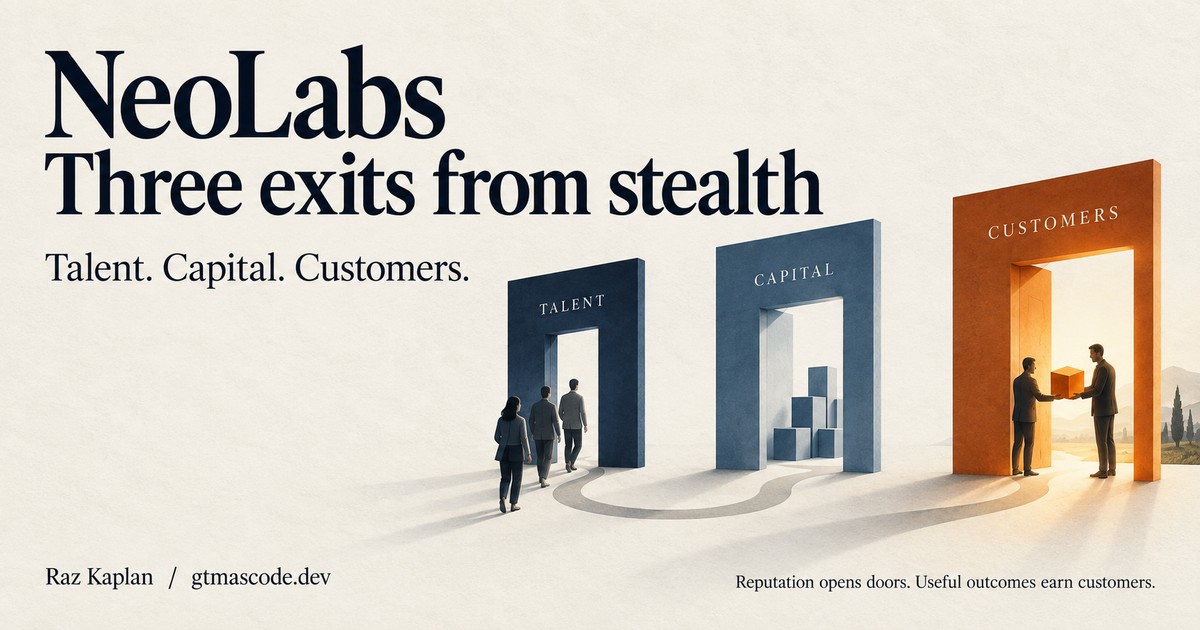
NeoLabs, the new wave of independent AI research companies, make a familiar modern marketing question unusually sharp: who is this launch actually for? A researcher deciding where to work, an investor buying a future breakthrough, and a customer buying an outcome are making three different decisions. One announcement can reach all three. It cannot supply the same proof to each.
In my last post on the end of building in public, I argued that public visibility needs to earn its place in a startup's strategy. These labs complicate that argument in a useful way. A company can be very public about its ambition while keeping its work largely private.
Three exits from stealth
By “exit,” I mean an exit from obscurity for a particular audience, not a sale of the company. These are three markets to win, not a mandatory sequence.
The first is talent. The founding announcement pitches a mission to people capable of advancing it. The founder's name supplies distribution; the research agenda gives a candidate a reason to join. A sparse website can be excellent employer branding if the intended reader already understands the team's work.
The second is capital. Investors underwrite a team, a technical thesis, and the possibility of an exceptional outcome. Founder reputation can compress diligence and open doors. It is not the only evidence investors see, and outsiders should not confuse a quiet website with an empty data room.
The scale is still striking. In October 2025, Reflection announced that it had raised $2 billion to build frontier open intelligence. That is a capital-market achievement. It answers a different question from whether a customer will renew.
The third is customers. Someone outside the lab uses what it produces, gets a useful result, and has a reason to return. This requires an artifact: a model, API, application, deployed system, or validated discovery. Something another organization can put to work.
My thesis is narrower than “reputation cannot buy customers.” Of course it can win attention, trials, and early contracts. Reputation can buy the first meeting. Sustained demand needs a useful outcome. Shipping is the beginning of that test, not proof that the test has been passed.
Four ways to approach the customer market
The difference between labs becomes clearer when you ask what they intend to put in a customer's hands.
An API developers can adopt. Thinking Machines made Tinker generally available on December 12, 2025, removing its waitlist and expanding its fine-tuning capabilities. The research brand brings developers to the door. The product gives them something to evaluate in their own work. Activation, repeat usage, and retention become more revealing than the founding announcement.
Scientific work an industrial partner can use. Periodic Labs describes autonomous laboratories and AI scientists, but also practical work with a semiconductor manufacturer on heat dissipation. That makes “the product is discoveries” too narrow. Models, tools, experiments, and partnerships can all form part of the offer. My GTM inference: the proof should be a better scientific or industrial outcome, rather than a large signup count.
Open models as distribution. Reflection's stated mission centers on open and accessible intelligence. An open release can create adoption, scrutiny, and downstream integrations before a conventional sales process begins. But distribution and monetization remain separate questions. Which users become buyers, and what do they pay for? Openness is a route to the market; it does not settle the business model by itself.
A deliberately longer research horizon. SSI's public mission explicitly insulates its work from short-term commercial pressure. Ineffable Intelligence similarly describes a window for ambitious research without near-term product demands. AMI Labs sets out a world-model research agenda with possible applications across industry. These are different technical bets, not evidence that a customer market will never arrive. The commercial question is deferred: what result will make the work useful outside the lab?
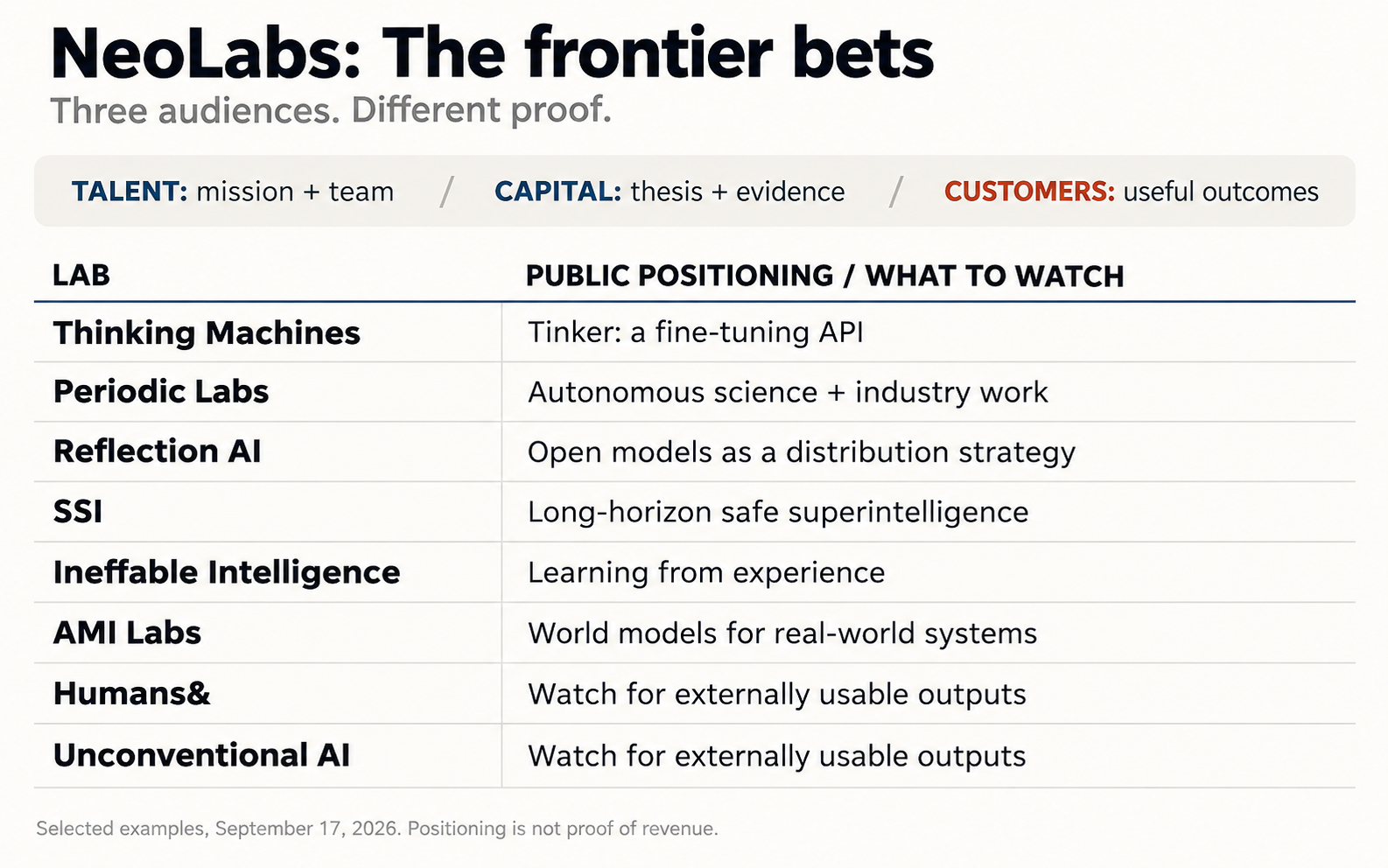
Selected frontier bets, reviewed September 17, 2026. This is a map of positioning and questions to investigate, not a ranking of revenue or research quality. Tap the image to enlarge.
A release is not the same as a customer
The broader wave includes robotics, world models, coding, science, voice, agents, and evaluation. The categories share a financing story, but their evidence of commercial progress is different.
World Labs' Marble gives users a world-generation product to work with. Cartesia offers voice technology developers can integrate into applications. Both make an outside evaluation possible. Neither a launch nor an API listing, by itself, tells us whether users keep paying.
Robotics makes that distinction especially important. A research model, a demonstration, a paid pilot, and a repeated deployment are different milestones. They should not share a single “shipped” marker.
Skild is a concrete example. On September 10, 2026, it reported crossing $100 million in annual recurring revenue, with more than 60 paying customers and $50 million already recognized since deployments began ten months earlier. Those are company-reported figures, not independently audited results. They are nevertheless commercial claims that a “research only” label would erase.
Poolside also shows why these maps age quickly. Its public site now offers open-weight Laguna coding models and links to ways to use them. A label saying “no public product” misses that change. Public availability still does not establish retention, margins, or product-market fit.
And a lab can generate substantial output without offering a self-serve product. In its 2025 financing announcement, Lila described operating an AI Science Factory and running hundreds of thousands of experiments. The next commercial question is who benefits from those results and on what terms. A missing signup button is a poor proxy for an absence of value.
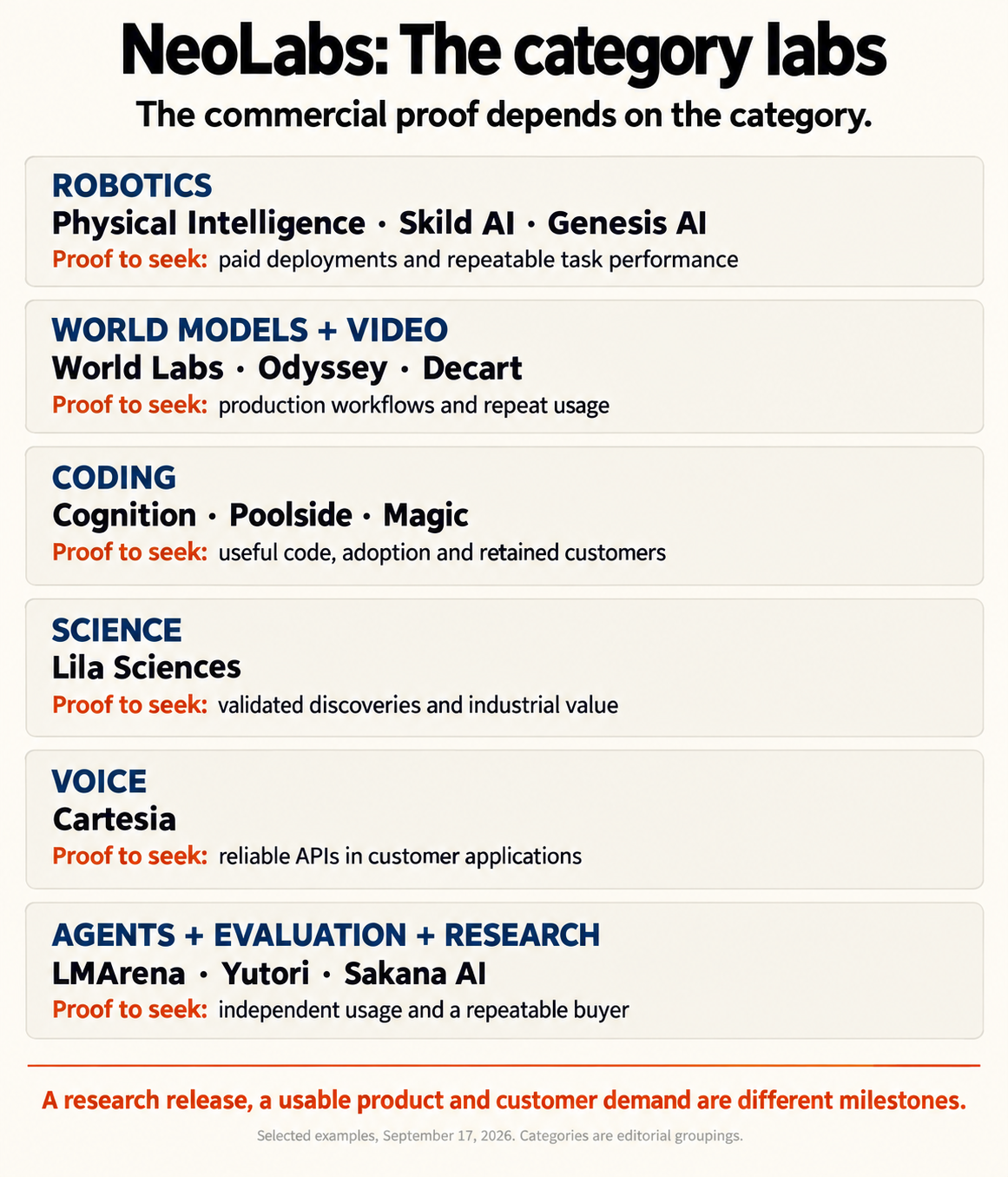
The wider lab landscape. These editorial groupings identify the proof to look for; inclusion does not assert that a company has or lacks customers. Tap the image to enlarge.
I would track three separate facts for each company: what it has released, who can use it, and what evidence exists that users receive enough value to stay. Collapsing those into one star produces a cleaner chart and a weaker argument.
The order is a choice
Cognition is a useful counterexample to a rigid talent-capital-customers sequence. It introduced Devin in March 2024, with early access and a disclosed $21 million Series A. A public artifact was part of the company's story well before its September 2025 financing of more than $400 million.
That was not “product before any capital.” It was product evidence before much larger amounts of capital. The distinction matters.
An artifact can recruit researchers and reassure investors as well as attract customers. These markets reinforce one another. The strategic choice is which one must supply the next piece of evidence.
Acquisition is another possible outcome, but it is not a fourth customer market. A buyer may value a team's capabilities, intellectual property, or infrastructure even when the standalone commercial model remains unproven. That can produce a financial exit. It does not demonstrate customer demand for the original product.
What would change my mind
A higher valuation next year would not falsify this thesis. It would show that investors still value the research option. A lab could also have private commercial relationships that public information fails to capture.
The more useful test is what happens after outsiders get access. Do customers renew because the product solves a problem? Do open-model users become a durable ecosystem or paying buyers? Do industrial partners expand work after an initial result? Can deployments be repeated without bespoke effort consuming their value?
If reputation alone reliably sustained paid usage despite weak outcomes, I would need to revise the argument. If a lab built an enduring business around licensing or partnerships without a public product, I would count that as commercial progress, not a failure of the framework.
The practical lesson for founders is to name the audience before planning the launch. A hiring announcement needs a credible mission. A funding story needs a credible research and operating thesis. A customer launch needs a usable offer and a way to measure whether it works.
The next time a famous researcher announces a lab, look past the size of the round. Ask: which market has this company won, what can someone outside it use, and what evidence must come next?
Share this post
Related Posts
Subscribe to the Newsletter
Get the latest insights on vibe coding and marketing delivered to your inbox.